
From the aspects of temperature resistance range, material hardness, insulation performance, thermal conductivity, bonding performance, etc., the specific distinctions are as follows.
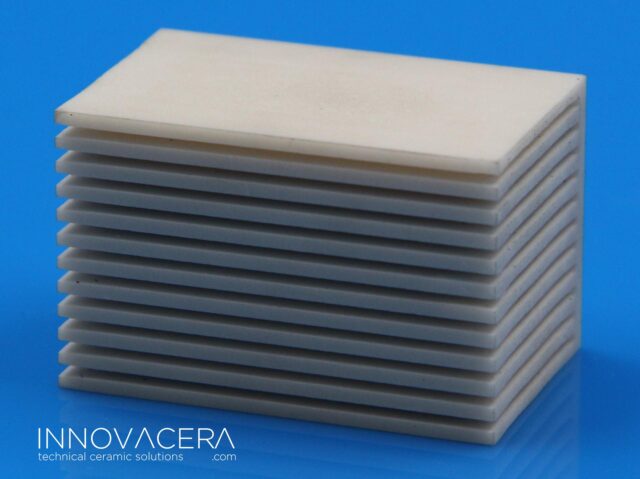
Thermal Conductive Silicone Sheet Performance and Characteristics
1. Thermal Conductive Silicone Sheet Temperature Resistance Range:
The high temperature working range of high thermal conductivity silicone sheets is 200℃, but ceramic heat sinks can be used normally in high temperature environments above 1700℃.
2. Material Hardness of Thermally Conductive Silicone Sheet:
Thermal conductive silica gel sheet is an elastic silica gel material with good compressibility, while ceramic heat sink is a high-hard ceramic material. In terms of hardness, ceramic heat sink fin is much higher than thermal conductive silica gel sheet.
3. Insulating Properties of Thermally Conductive Silicone Sheets:
The breakdown voltage of the thermally conductive silicone sheet is 4.5KV/mm, while the breakdown voltage of the ceramic heat sink is 15KV/mm, and the volume resistance of the ceramic heat sink is also as high as 1012Ω·m.
Ceramic Heat Sink Performance and Characteristics
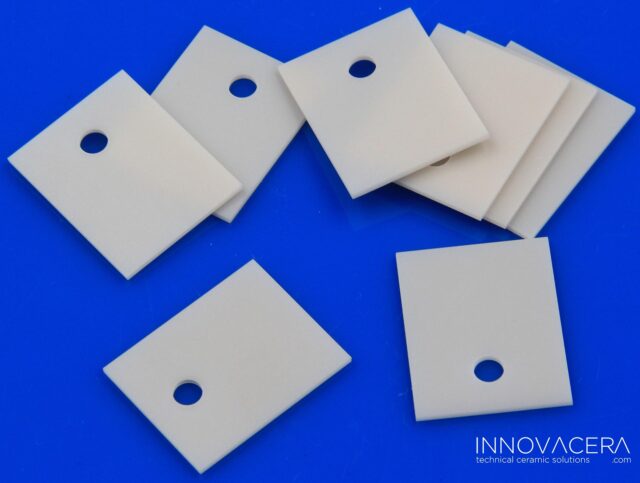
1. Thermal Conductivity of Ceramic Heat Sink:
The thermal conductivity of thermal silica gel sheets is far inferior to that of thermally conductive ceramic sheets doped with a large amount of alumina and aluminum nitride. The thermal conductivity of alumina ceramic heat sinks is more than 5 times that of high thermal conductivity silica gel sheets.
2. Fitting Performance of Ceramic Heat Sink:
The good insulation and soft tape properties of the thermally conductive silicone sheet make it extremely superior in conformability, and also make it widely used in heat conduction and heat dissipation on the chips of various electronic products. However, the heat transfer of the thermally conductive ceramic sheet requires a certain amount of thermal conductivity. Silicone grease increases its conformability, which is one of the main reasons why thermally conductive ceramic sheets are not widely used in electronic products for heat conduction and heat dissipation.
The Following is A Summary:
| Thermal conductive material | Thermal conductive silicone sheet | Ceramic heat sink |
| Temperature resistance range | 200℃ | 1700℃ |
| Hardness | Low | High |
| Insulating (breakdown voltage) | 4.5KV/mm | 15KV/mm |
| Thermal conductivity | Low | 5 times |
| Fitting performance | Good | Not very good |
Conclusion
Because each thermal conductive material has electronic thermal conductivity and heat dissipation application scenarios that are adapted to its characteristics, customers need to choose the required heat dissipation material according to their needs.

